Astro-chimps: The History of Chimps in Space
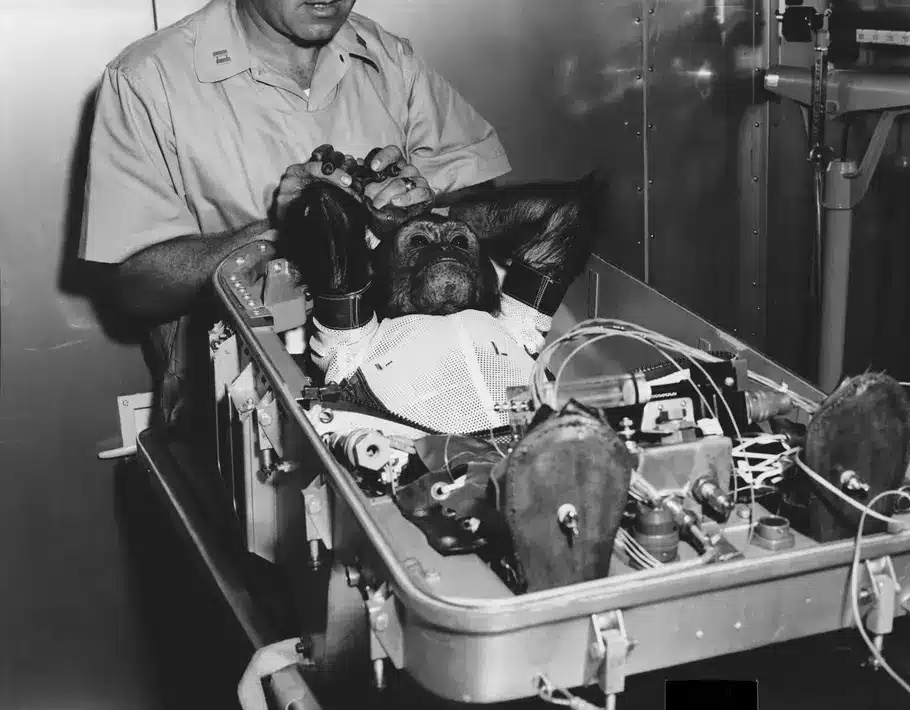
You may have heard of the first astronauts in space. The people both the United States and Soviet Union (USSR) sent into space returned heroes. But far less people know the names and stories of the animals sent before humans ever were. From cats and dogs to small and large primates, the space race pushed countries to risky experiments in the name of reaching the last frontier for mankind. In honor of the recent launch of the Artemis 2, we at Project Chimps want to look at the history of chimpanzees in space, and the impact they made for the humans that came after.
The History of Chimps in Space
While the Soviet Union was making successful launch and return attempts with stray dogs, the United States decided to take a different route to prepare for humankind’s ascension to the stars: primates. While the first primates launched into space by the U.S. were small monkeys, their choice of who would make the first “manned” flights fell upon our closest cousins: chimpanzees.
NASA made this decision based on the apes’ high intelligence, complex emotions, and shared physical motor skills. Their likeness to us in these regards led scientists to think if a chimp could endure the journey into space and back, humans could too. So early space capsules were designed to test the intelligence and dexterity needed to operate a spacecraft.
The program was called Project Mercury. The U.S. Air Force purchased forty chimpanzees and trained them to perform motor tasks in space. They learned to pull levers in response to sound and light and received rewards such as banana pellets when correct, or “mild shocks” to their feet when wrong. Such forms of invasive experimentation on chimpanzees remained legal until 2015.
Eventually, these tests weeded out those deemed poor performers. Out of 40 chimpanzees in the program, only two came to occupy the seats of the Mercury capsules: Ham and Enos.
One Small Step, One Giant Leap
Ham was the chimpanzee chosen for the first “manned” test flight in space. His job was the same as all the tasks the chimps of the program were trained to do: pull certain levers in response to the sound and light patterns emitted in the capsule. These tests allowed NASA to gauge how zero-gravity and acceleration affected his motor skills.
He was fitted for a special capsule, referred to as a “couch-cabin,” that would go inside the spacecraft. This couch-cabin would protect Ham, allowing him to breathe in case the cabin pressure within the spacecraft failed. On January 31, 1961, three months before Alan Shepard became the first man in space, Ham became the first chimp in space.
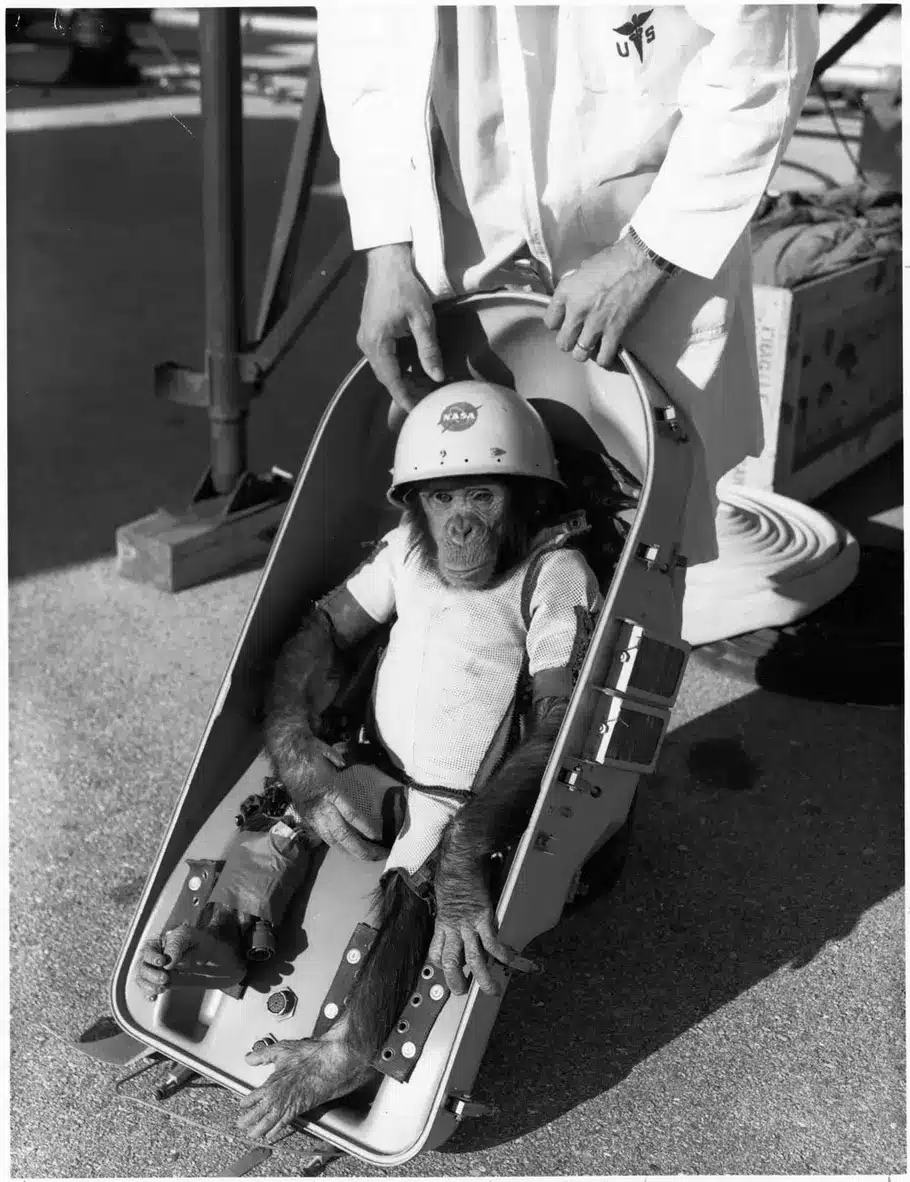
Ham’s Flight in Space
But, as was common for those primitive spaceflights, the mission did not go as planned. The original plan had Ham traveling at an altitude of 115 miles at speeds up to 4,400mph. But technical problems led to the craft carrying the unaware passenger up to 157 miles at a speed of 5,857 mph, landing 422 miles downrange instead of the expected 290 miles. Fortunately, crisis averted. Despite a partial loss of air pressure in the cabin, Ham’s capsule proved efficient in keeping him in an oxygenated environment. He was in flight for 18 minutes and recovered safely after splashing down in the Atlantic. The “astro-chimp” performed well during his mission despite the unplanned circumstances.
Ham proved physical and mental capability while being in orbit just outside Earth’s atmosphere, providing medical evidence that humans would be safe and able to accomplish physical tasks. It’s thanks to him that the astronauts to come were full of confidence.
Fighting to Place in the Race
Ham wasn’t the only chimp to play a part in the space race. While Enos may not have reached the same celebrity status Ham did, one could argue his achievement outdid his predecessor as the first chimpanzee to orbit the Earth.
To clarify, Enos was only the third hominid to orbit the Earth. Two Russian cosmonauts beat him to it: Yuri Gagarin and Gherman Titov. His American predecessors, Alan Shepard and Gus Grissom, only made suborbital journeys. Because of this, America was behind in the space race and was desperate to put a man in orbit. But NASA didn’t have the experience Russia did and were cautious to put a person on one of their rockets. Rather than select a human, NASA decided the Mercury-Atlas 5 (MA-5) mission would be “manned” by another chimp. Enos was chosen for destiny.
Like Ham, Enos was put in a pressurized “primate capsule” that would let him breathe in case cabin pressure failed. At 10:08 am, November 29, 1961, Enos launched into orbit, experiencing gravitational forces nearly eight times Earth’s gravity before becoming completely weightless. Strapped into his couch-cabin, he had three levers and several lights before him. Enos’s cognitive tasks were more elaborate than Ham’s due to the extended flight period of five hours.
Trouble in Spaceflight
The tests followed the same rules as the previous ones. Correct answers were rewarded with water and banana pellets. Wrong ones punished with a “mild shock” to the left foot. Unfortunately, this system failed after the fourth task, and despite whether he was correct or not, Enos received a shock every time he pulled the central lever. But in a surprising display of resilience, he continued to complete his work despite the harsh conditions.
After more problems with the Mercury capsule, NASA made a quick decision to pull the spacecraft from orbit. Enos made it back to Earth alive, but not without incident. He had become upset and broke through the restraints within his capsule, going on to rip off his medical sensors and urinary catheter. Though he calmed down after retrieval, NASA was “not very frank with the press” because of what happened.
Though Enos is less famous than Ham, his accomplishment pushed the first American astronauts into orbit. He was a pioneer of space travel that deserves the same respect as all space heroes. Through hardship, he joined Ham as one of the chimps in space.
A Legacy for the Stars
While the history surrounding humanity’s earliest attempts at space travel were complicated, there’s much to celebrate, too. The recent Artemis 2 launch is just one of many to come in a future we can only dream of today.
So, while we celebrate our most recent heroes, we should also remember those of the past that led us to this moment, both human and non-human. Ham and Enos were pivotal in their roles of spaceflight. Without them, we may never have put a man on the moon.
In memory of the many animal heroes that made space travel possible, including Ham and Enos, consider sponsoring a former research chimp that deserves the same love as our astro-chimps. Or if you’d like to read more about the history of chimpanzees in research, learn more in this blog!