The Doctor Is In: Meet Project Chimp’s Veterinary Medical Director

By Rachel Dragas
Meet Dr. Jenny Jaffe—Project Chimp’s new Veterinary Medical Director, and learn about how she is shaping the medical program at the sanctuary.
Meet Jenny
Dr. Jenny Jaffe has been with us for eight months now. Jenny is Dutch American; born in Virginia, she moved to Holland with her family as a child, and that’s where she completed most of her education. At 19, she had been on an exchange year in Costa Rica and volunteered with folks who were in charge of protecting wildlife. They had rescued a capuchin monkey who had been kept at an illegal zoo, and Jenny helped take care of it before it was sent to a sanctuary. “I knew then that working in wildlife protection, specifically with monkeys, was something I wanted to do with my life.”
In Holland, veterinary school is a six-year program: four years of theory and two years of practical, very little of which involved primates. During her summers, Jenny volunteered at sanctuaries, and a chimpanzee reintroduction project in Congo. She also pursued a research internship at a primate sanctuary in Holland. She completed three years in general practice and then started her wildlife trajectory working in a remote sanctuary in an Ecuadorian rainforest. Jenny also worked with orangutans at a sanctuary in Borneo. These experiences furthered her resolve, and, to gain more wildlife background training, she went on to pursue a Master’s program in London.
She then worked at Tacugama Chimpanzee Sanctuary in Sierra Leone. Her work at the Institute of Zoology in London involved reintroductions of British wildlife, while her PhD program involved field work at the Taï Chimpanzee Project in the Ivory Coast.
The Journey to Project Chimps
While writing up her PhD dissertation, Jenny was also working on the side as a small animal veterinarian. It was during this time that she was recruited by Project Chimps for the position of Veterinary Medical Director. “The team had been searching for quite some time for the right candidate with the appropriate background and experience, and were willing to wait for my licensing process which would allow me to work in America.” After the initial interviews, she knew the sanctuary was the perfect fit. Jenny already had family living in Atlanta and those local roots helped with her transition over to the USA.
Dr. Jenny officially started at Project Chimps on November 1st, 2024.
Life at the Sanctuary
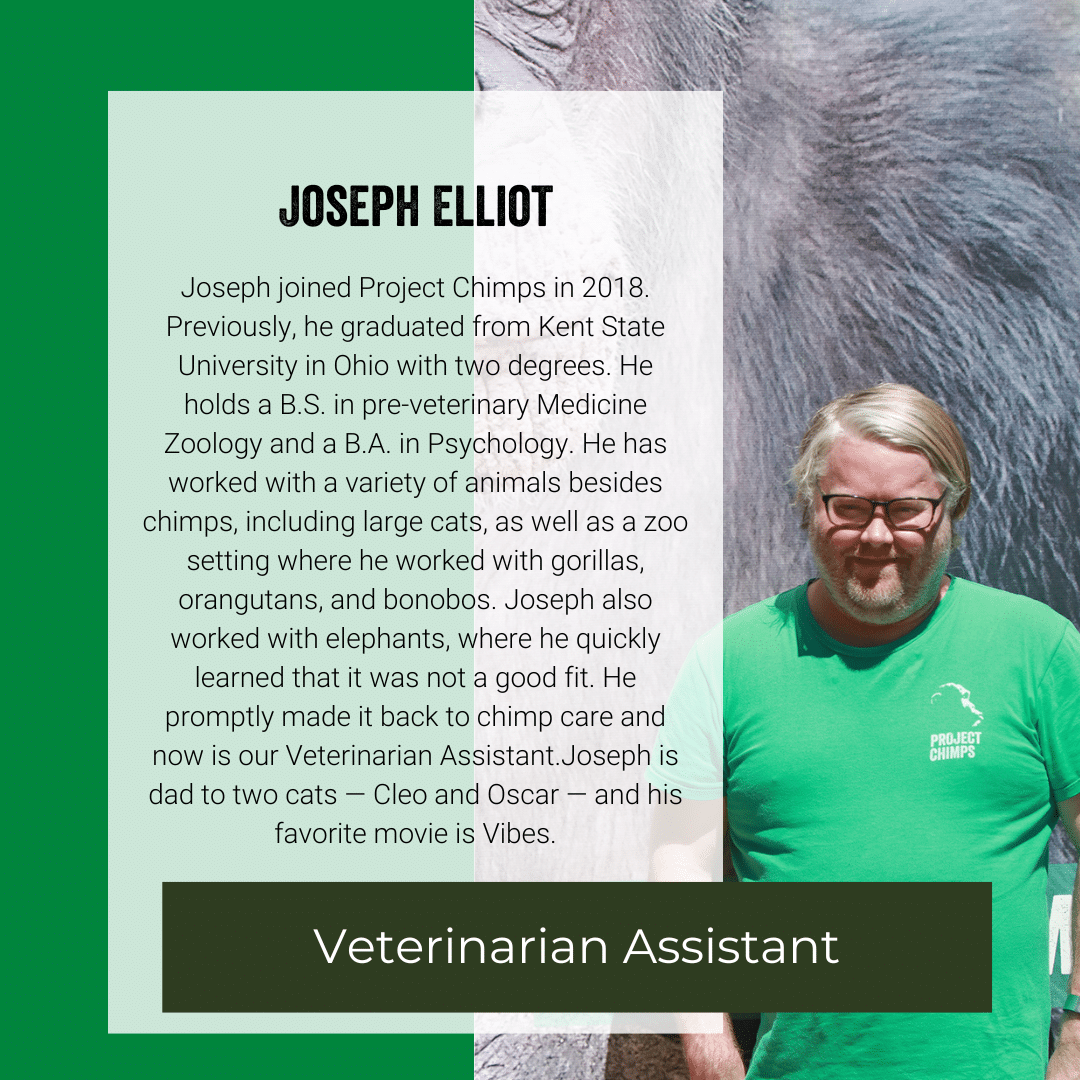
Every day is different at the sanctuary, but will usually start with a morning staff meeting at 8am. Dr. Jenny will then check messages and pending clinical tests, and start her morning rounds with Joseph Elliot, the vet assistant, or Kris Dyer, the behaviorist. They will visit each villa, check in with the primary caregiver, and inquire about any health or behavioral matters. If the situation permits, they will also apply positive reinforcement training to facilitate specific actions, such as inspecting wounds or preparing injections. “The great thing about rounds is I get to see most, if not all of the chimps, every day; they see and know me, and positively associate me with the snacks that are used for training.”
Rounds typically last 1-2 hours. “The rest of the day isn’t as glamorous and involves routine tests or updating documents.” There are two chimps at Project Chimps with kidney disease, so if there is a urine sample that has been collected, for example, Dr. Jenny will complete an urinalysis.
Dr. Jenny also oversees the routine physical examinations at the sanctuary. The veterinary team, along with skilled medical volunteers—including a physician’s assistant and nurse practitioner—plans the exams in advance and performs them under anesthesia with support from the vet assistant. “We do x-rays, run blood and urine analyses, and ensure that all the findings are properly documented.”
Shaping the Medical Program: A Collaborative Approach
As Veterinary Medical Director, Dr. Jenny oversees the medical program to ensure that the procedures we have in place are well documented. She also regularly consults with vets at other primate sanctuaries in the USA. On her days off, she visits vets in the region including Chattanooga Zoo, University of Tennessee in Knoxville, and University of Georgia in Athens, with the intent of establishing a network for communication and knowledge sharing.
One of our male chimps, Bo, sustained a chronic foot infection from an old injury that had affected the bone. As Dr. Jenny and the team had exhausted all approaches to no avail, she utilized this clinical network for consultation. The medical team agreed to perform a partial amputation to remove the infected fractured bone. “We had the specialist vet from the University of Tennessee come over with a whole team; we did the anesthesia and x-rays, and they performed the operation.”
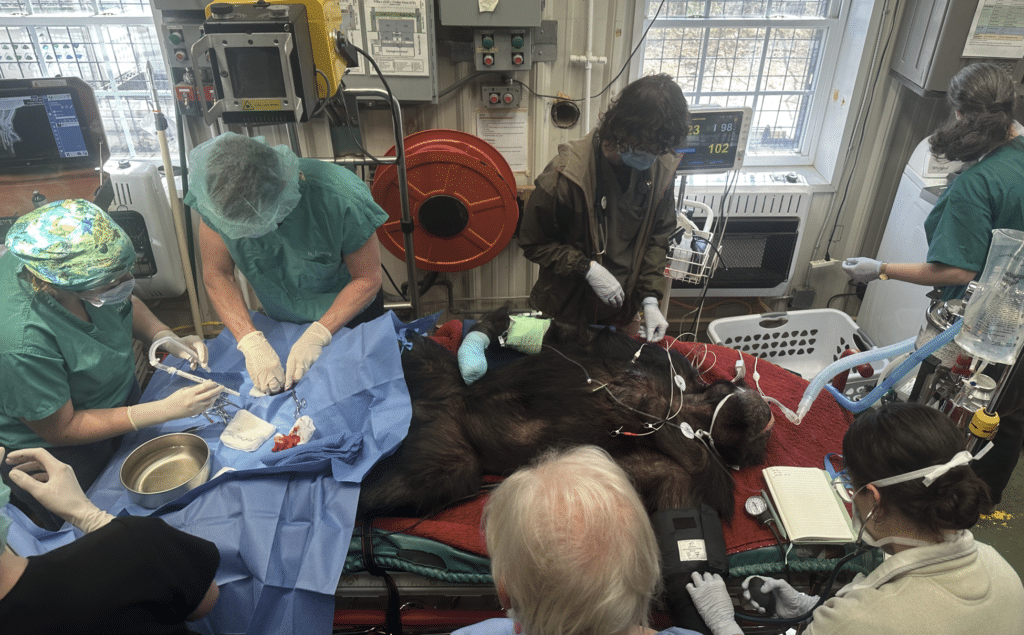
Another example of this collaborative approach involved a female chimp who had not been consistently taking oral birth control for quite some time. Researchers have found that intrauterine devices (IUDs) work relatively well in chimps and remain effective for approximately 12 years. Project Chimps’ medical volunteers include a gynecologist; she was able to successfully implant an IUD in the chimp, who has been doing well since.
Another chimp, Kevin, had been grappling with a facial infection and swelling due to previously damaged cartilage. “We had him on long-term antibiotics, but the issue persisted, and a senior plastic surgeon from Atlanta agreed to come over and help us address this challenge.”
Teamwork Makes the Dream Work
Jenny feels very appreciated at the sanctuary and is grateful for the team and broader support network. “Everyone always says they’re so happy I’m here, which is funny because I feel like I’m the lucky one—being able to do what I love while striving to give these chimps the best life that we can.” It’s a very collaborative job and Jenny is in great company. “The care staff are extremely important, as well as my vet assistant, and the greater network of specialists and volunteers that come here regularly to help. We’re very lucky to have the support that we do.”
Learn more about Project Chimps and ways that you can support here.