Chimp Enrichment – Why Is It Important?
By Lauren Vogel
What enrichment means for chimps
Every day at a chimpanzee sanctuary begins with the same question: How do we help these incredibly intelligent animals live full, engaging lives? At Project Chimps, enrichment is a core part of our mission. We work to ensure that every chimp is stimulated socially, cognitively, and physically.
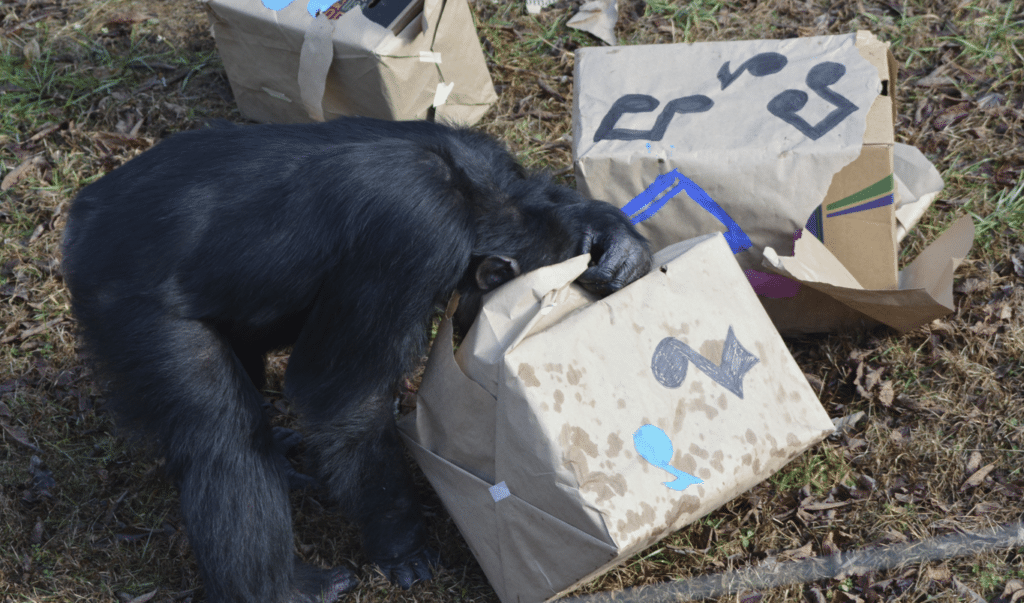
Enrichment encourages natural behaviors and instincts. As caregiver and enrichment committee co‑facilitator Eva Bryant explains, “Enrichment is the many ways staff can encourage chimpanzees to utilize their natural behaviors and instincts.” At Project Chimps, enrichment can include food puzzles, swings, foraging opportunities, and even movies.
Why enrichment is essential to chimp well‑being
For chimps living in sanctuary, enrichment is critical to preventing boredom and stress. Because their food is provided daily, they no longer need to hunt or forage—activities that would normally occupy much of their time and mental energy. Without substitutes for these natural behaviors, chimps can become under‑stimulated.
Eva notes, “If we don’t provide ways for them to utilize tools or search for food, they will still express these behaviors—but in less safe or disruptive ways.” Enrichment activities help redirect these instincts into safe, healthy outlets.
Chimp personalities – one size never fits all
Just like humans, chimpanzees have individual preferences, quirks, and problem‑solving styles. These differences must be considered when designing enrichment.
Eva shared a story about Precious, one of our female chimps. She was given a cloth firehose tied in a knot with nuts hidden inside. The goal was for her to untie the knot to reach the treat. Instead, Precious slammed the toy on the ground repeatedly, hoping the nuts would fall out. “The next day, I found the knot she had, and it still had the nuts inside—pulverized to a powder!” Eva recalled. Now, caregivers partially untie the knot to give Precious a fair chance before her patience runs out.
Precious is just one example—many chimps across the sanctuary need their enrichment tailored to their abilities and personalities.
Planning enrichment – structure, creativity, and teamwork
Because our chimps live in large social groups, enrichment is planned for the group rather than for individuals. We use two main types of enrichment: themes and assigned daily enrichment.
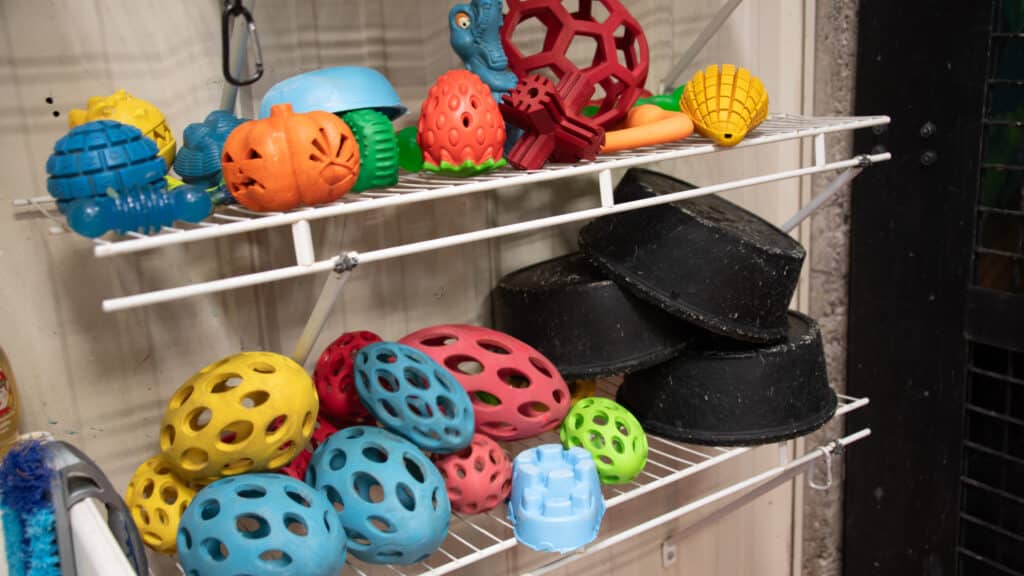
- Themes – Usually less food‑based. Caregivers select toys or items they believe the whole group will enjoy. On a chimp’s birthday, caregivers choose that chimp’s favorite enrichment item as a special treat!
- Assigned Daily Chimp Enrichment – Typically food puzzles assigned by the enrichment committee to ensure variety. Caregivers then decide how to present the item, making enrichment a true team effort.
As Eva puts it, “Each enrichment item we present to the chimps represents a team of people.”
Trial, adaptation, and learning from the chimps
Even with a wide range of enrichment options, it takes time and experimentation to find what works best. “When an enrichment activity doesn’t land the way we expected, we pivot,” Eva says.
She recalled creating “PVC icees”—PVC tubes with tiny holes filled with frozen juice. The idea was that the juice would melt slowly and the chimps would slurp it out. Instead, the toy was difficult to make and created a huge mess. The team adapted the design, filling the tubes with dry mix instead. These “dry mix droppers” became a sanctuary favorite—except in the Chimps Ahoy group.
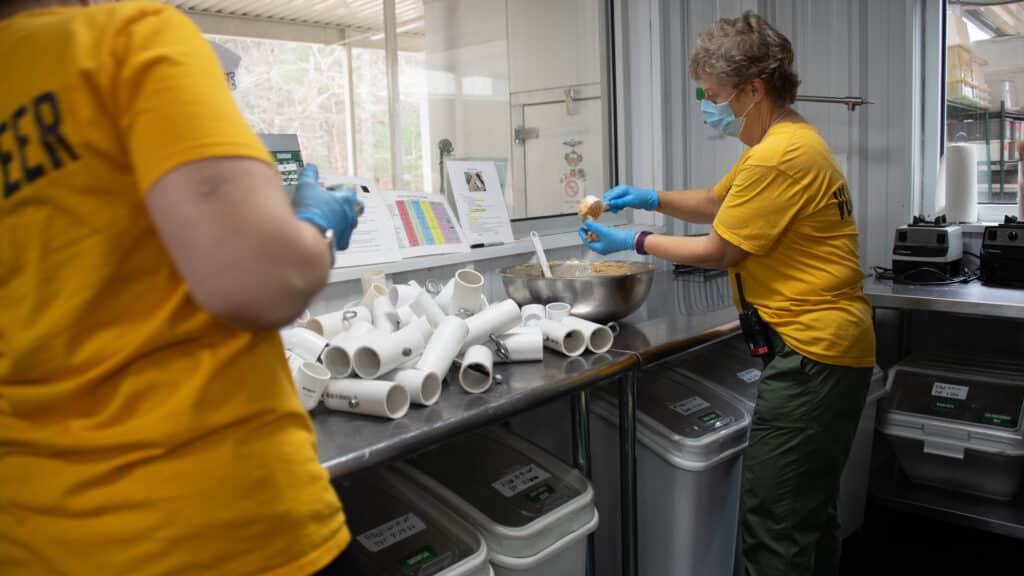
Rosemary, a chimp with a smaller, more dexterous hand due to missing fingers, quickly learned to unscrew the droppers and dump the entire contents into her mouth, leaving none for her groupmates. “So, for Chimps Ahoy Villa, we don’t use dry mix droppers and are currently working on a Rosemary‑proof version!”
Listening to the chimps – and what they teach us
Caregivers rely heavily on the chimps’ reactions to determine whether an enrichment activity is successful. Body language, excitement, and engagement all offer clues. If the chimps stay interested and the activity is efficient for staff to prepare, it’s considered a win. Eva adds that the team “loves to hear happy food grunts when bringing out food items for the chimps!”
Chimps also communicate when they don’t like something—by ignoring it or refusing to take it. Group dynamics matter too. For example, Mandy, a lower‑ranking chimp, sometimes receives negative attention from others if she takes food items in the same room as the males. Caregivers now recognize when Mandy prefers to enjoy her enrichment in a separate space.
Why enrichment matters
Chimpanzees are highly intelligent, and without proper stimulation, they can become bored or stressed—both of which can impact their health. Enrichment keeps them mentally and physically engaged, but it requires creativity, observation, and teamwork.
“It takes a team!” Eva emphasizes. “Our amazing volunteers and staff all do an incredible job preparing enrichment, coming up with new ideas, and helping us problem‑solve when we need to pivot. Each enrichment item we present to the chimps represents a team of people who all discussed the chimps’ safety, enjoyment, and health.”